
What the arm gets wrong
We build robotic arms from rigid links and central controllers. The elephant and the octopus build theirs from soft tissue and distributed intelligence. One approach has been working for fifty million years. The other keeps failing in unstructured environments.
Pick up a glass of water. Not with a robotic arm — with your hand. You did not calculate the angle of each finger joint. You did not compute the grip force required per square centimetre of glass surface. You just reached, and your body figured out the rest.
Now watch a factory robot pick up a glass. It was programmed for that glass, that position, that surface, in that lighting. Move the glass two centimetres and the robot misses. Change the glass to a cup and it needs reprogramming. The robot is precise, but it is brittle in a way that no living arm ever is.
We have been building robotic arms for sixty years and the best ones still fail at tasks a child manages before their second birthday. It is worth asking why. The answer, it turns out, was already in the animal kingdom, waiting.
The problem with bones
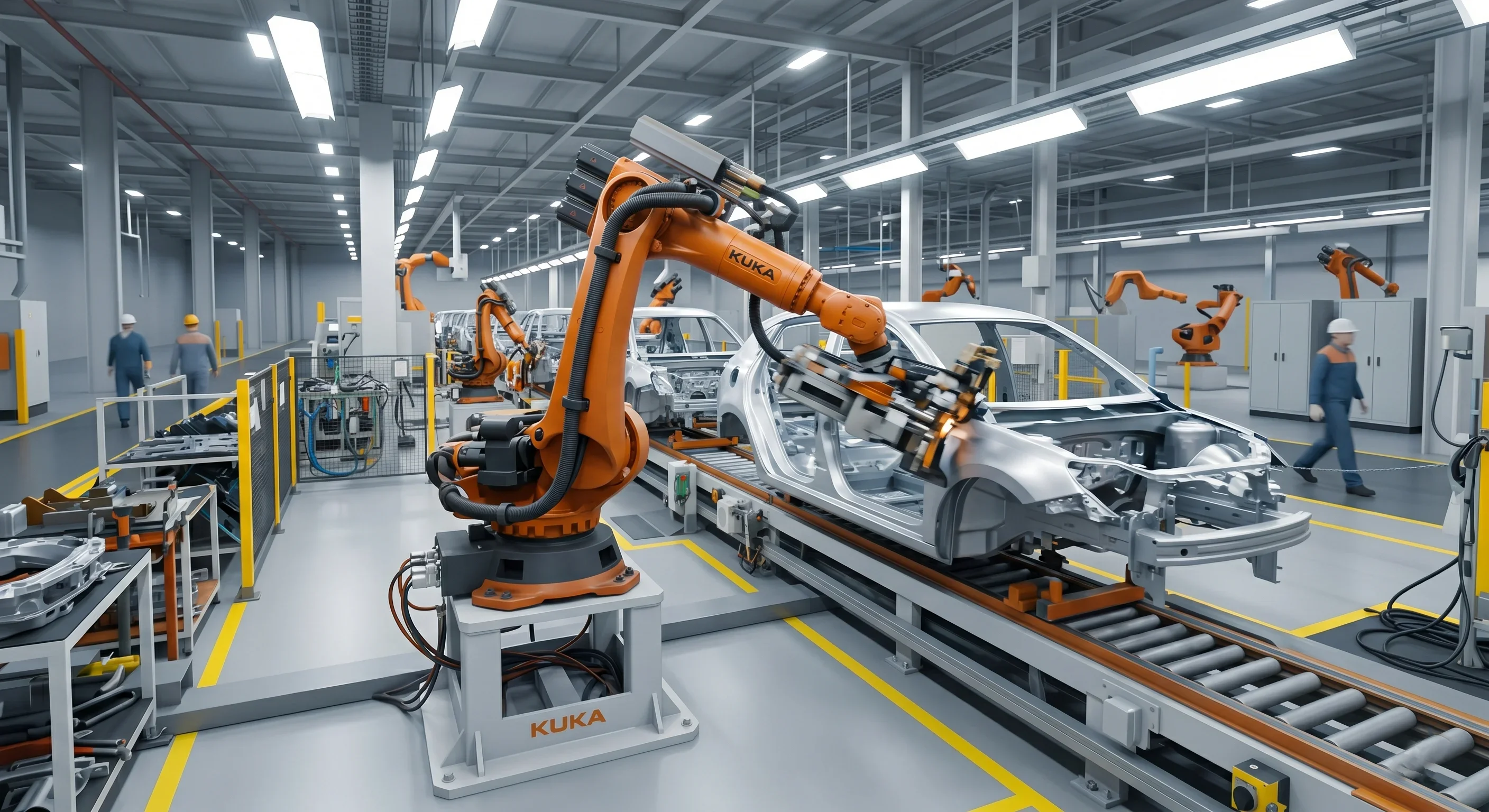
A conventional robotic arm is a kinematic chain. Rigid links connected at fixed joints, each joint driven by a motor, each motor receiving position commands from a central processor. It is a beautiful engineering structure. It is also a direct copy of the human skeleton, which is itself a compromise that evolution settled on for reasons that have nothing to do with manipulation.
The skeleton is good at load-bearing and locomotion. For fine manipulation, the real work is done not by bones but by the soft tissue around them: tendons, muscles, skin, the dense network of nerve endings in the fingertips. When we built robotic arms, we kept the bones and threw away everything else.
A rigid link can only be in one position at a time. A soft continuum arm can simultaneously curve at the base, extend at the middle, and rotate at the tip. These are not sequential positions. They are simultaneous states, which is what real manipulation in unstructured environments actually requires.
The industrial robot has no skin. It has no sense of contact beyond what its force sensors report. It cannot feel that the glass is slipping before it drops. It cannot adjust its grip mid-motion because the motion was planned before contact was made. Every limitation traces back to the same root: rigidity was chosen for repeatability, and repeatability was chosen because the environment was controlled.
Take the robot out of the controlled environment and the whole architecture collapses.
What the elephant brings
The elephant trunk is the mechanical counter-argument. It has no bones. It has forty thousand muscle units arranged in longitudinal, transverse, and oblique layers. The oblique layer alone allows the trunk to twist and elongate at the same moment — a simultaneous multi-axis motion that no rigid-link structure can replicate in a single actuated element.
But the mechanical lesson is not just about flexibility. It is about force range. The trunk can uproot a fully grown tree and, within minutes, use the same structure to place a single acacia pod gently on the ground without bruising it. The force range is enormous. The precision is extraordinary. And it is achieved not by switching between different tools or control modes, but by selectively recruiting different combinations of those forty thousand muscle units.

For robotics, this translates to a specific design argument: variable stiffness actuation. A soft arm that can stiffen selectively, that can be compliant at the tip while rigid at the base, that can store and release energy through elastic deformation rather than fighting it. Pneumatic and hydraulic soft actuators are already exploring this. Cable-driven arms with variable-stiffness sheaths are showing early promise in surgical robotics. The elephant is the proof of concept. The engineering is catching up.
What the octopus brings
The octopus solves a different half of the problem. Where the elephant gives us the mechanical model, the octopus gives us the control model.
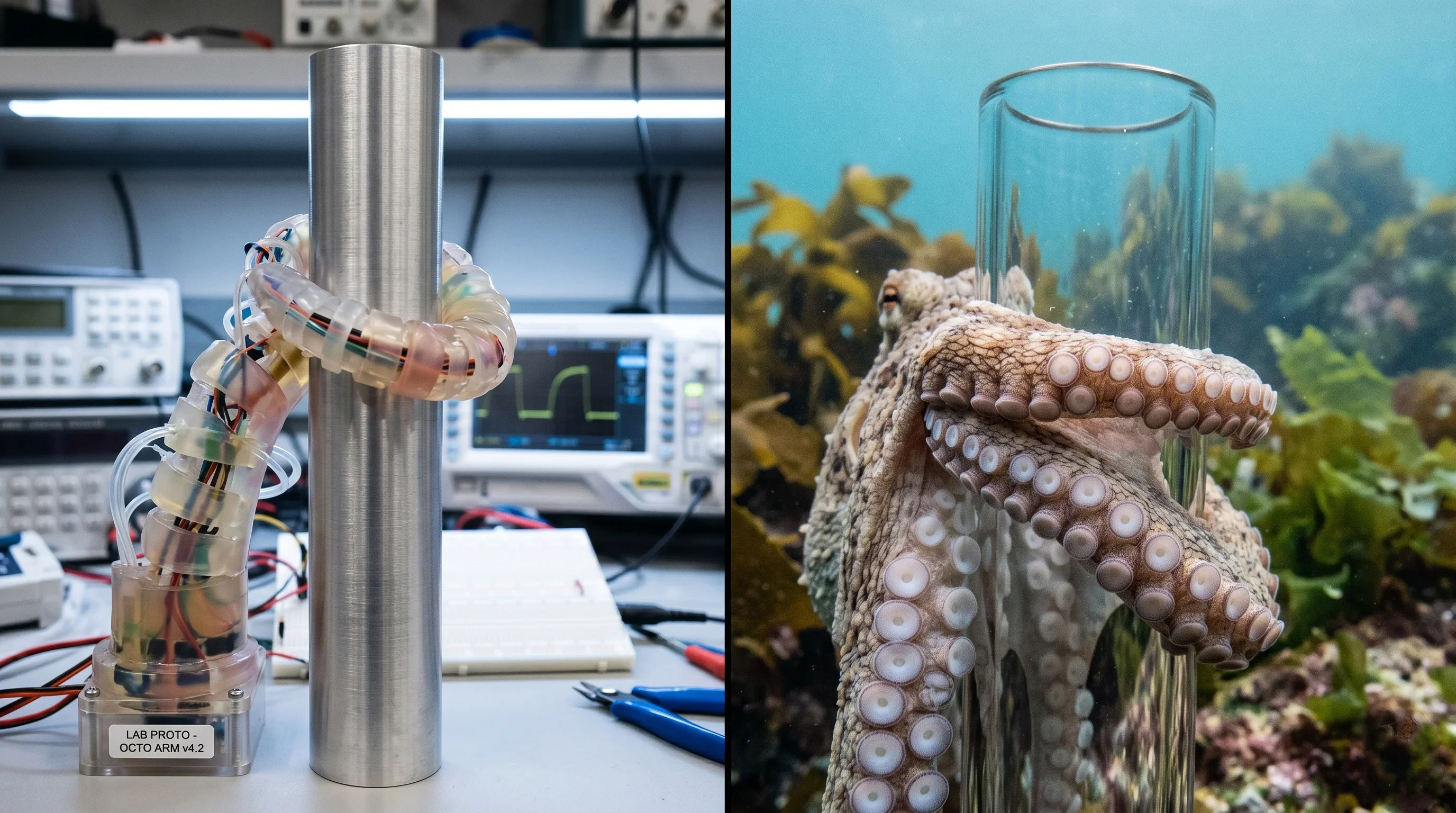
An octopus arm contains roughly two thirds of the animal's total neurons. It has its own dedicated nerve cluster, a ganglion, that processes local sensory information and executes local movement without waiting for instruction from the brain. When an octopus reaches for food, the brain issues a goal, not a trajectory. The arm navigates the path on its own.
Researchers have kept a severed octopus arm alive in isolation and shown that it continues to respond to touch stimuli and execute reaching motions independently. The intelligence is distributed into the limb itself. The central brain does not know exactly where the arm is at every moment. It knows what it wants. The arm handles the rest.
This is the architectural shift that conventional robotics has not made. Current systems route every sensor reading up to the central processor, which computes the response and sends motor commands back down. The latency is small but the fragility is large: any gap in the sensory data, any unexpected contact, any deviation from the planned trajectory, and the whole system must pause and recompute.
Distributed control means putting a small processor at each segment of the arm that handles local collision response, local grip adjustment, local compliance. The central system only sees outcomes. The arm handles events. This is not a new idea in robotics research, but it has not yet become the dominant architecture, because it is harder to certify, harder to predict, and harder to debug than the centralised alternative.
It is also, by every biological measure, the correct one.
The synthesis
What happens when you take the elephant's mechanical model and the octopus's control model and put them together?
You get an arm that is soft and variable in stiffness, so it does not break when it meets an unexpected obstacle. It bends around the problem rather than stopping at it. You get an arm with distributed local intelligence, so each segment responds to contact information in real time without waiting for the central controller to catch up. You get an arm that navigates by feedback rather than geometry, so it does not need to know exactly where it is as long as it can feel what it is touching.
This is not a robot that works in a factory doing the same motion ten thousand times a day. This is a robot that works in the real world: on a construction site where no two surfaces are identical, in a surgical theatre where tissue responds unpredictably, in a household where a glass might be anywhere and a hand might be everywhere.
We have been building robotic arms that are fast, repeatable, and precise in controlled environments. We need arms that are adaptive, compliant, and intelligent in uncontrolled ones. The biological evidence for how to do that has been sitting in the animal kingdom for fifty million years.
The elephant knew. The octopus knew. The engineering is just beginning to catch up.