
Two bodies, one idea
One lifts trees. The other opens jars. Neither has a skeleton where it counts. What the elephant trunk and the octopus arm share might be the most elegant engineering idea in nature.
In Amboseli, on a dry afternoon, an elephant reaches into a thorn thicket and pulls out a single acacia pod without disturbing a branch. The trunk moves like it is thinking. No bone. No joint. No hinge. Just forty thousand muscles negotiating with each other in real time, arriving at exactly the right shape for the task.
Twelve thousand kilometres away, in a cold Pacific tidal pool, an octopus unscrews the lid of a jar. It has never seen a jar before. It figures it out in under two minutes. Its arm has no skeleton either. Just three layers of muscle running in different directions, co-contracting until the arm becomes whatever it needs to be.
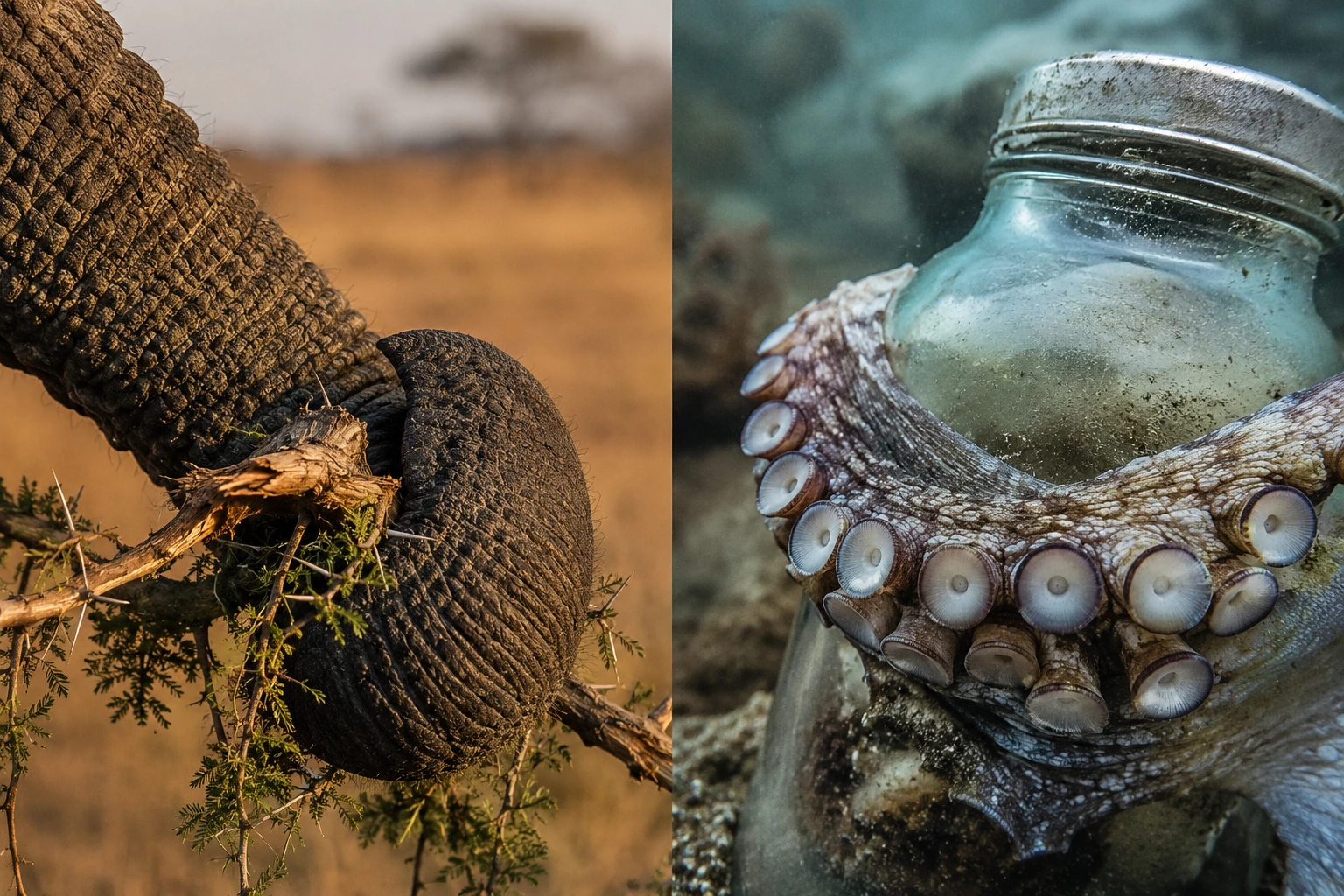
Two animals. Two different oceans of evolutionary time. One shared solution to the same hard problem: how do you build something that is both powerful and delicate, stiff and soft, precise and strong, all in the same structure, without any rigid frame to lean on?
The hydrostatic skeleton
Bones are good at one thing: they hold a fixed shape under load. But they are terrible at being two shapes at once. Your arm is either bent or straight. It cannot be half-bent at the middle while still extending at the tip. The geometry does not allow it.
A muscular hydrostat has no such problem. The trick is internal pressure. When muscle fibres contract in one direction, the tissue is forced to extend or rotate in another, because the total volume stays constant. The arm is essentially a liquid-filled bag that reshapes itself by squeezing different walls.
The elephant trunk has longitudinal muscles running along its length, transverse muscles running across, and oblique muscles running diagonally. It is the oblique layer that allows the trunk to twist and elongate simultaneously — a motion no hinged structure can perform. The octopus arm has the same three-layer arrangement. Neither animal invented this. Evolution wrote the same solution twice.
What makes this remarkable is not just the flexibility. It is the precision that comes with it. A fully grown African elephant can use its trunk to pick up a single coin from a flat surface. The same trunk, minutes later, will uproot a tree. Not by switching tools. By changing which muscles it recruits, in what sequence, at what tension.
Sensing without counting
Here is something stranger still. Neither animal tracks exactly where its appendage is.
Your brain knows your hand is at your side because it receives continuous angle data from every joint between your shoulder and your fingertips. The system is precise because it is rigid — the geometry is fixed, so position is always calculable.
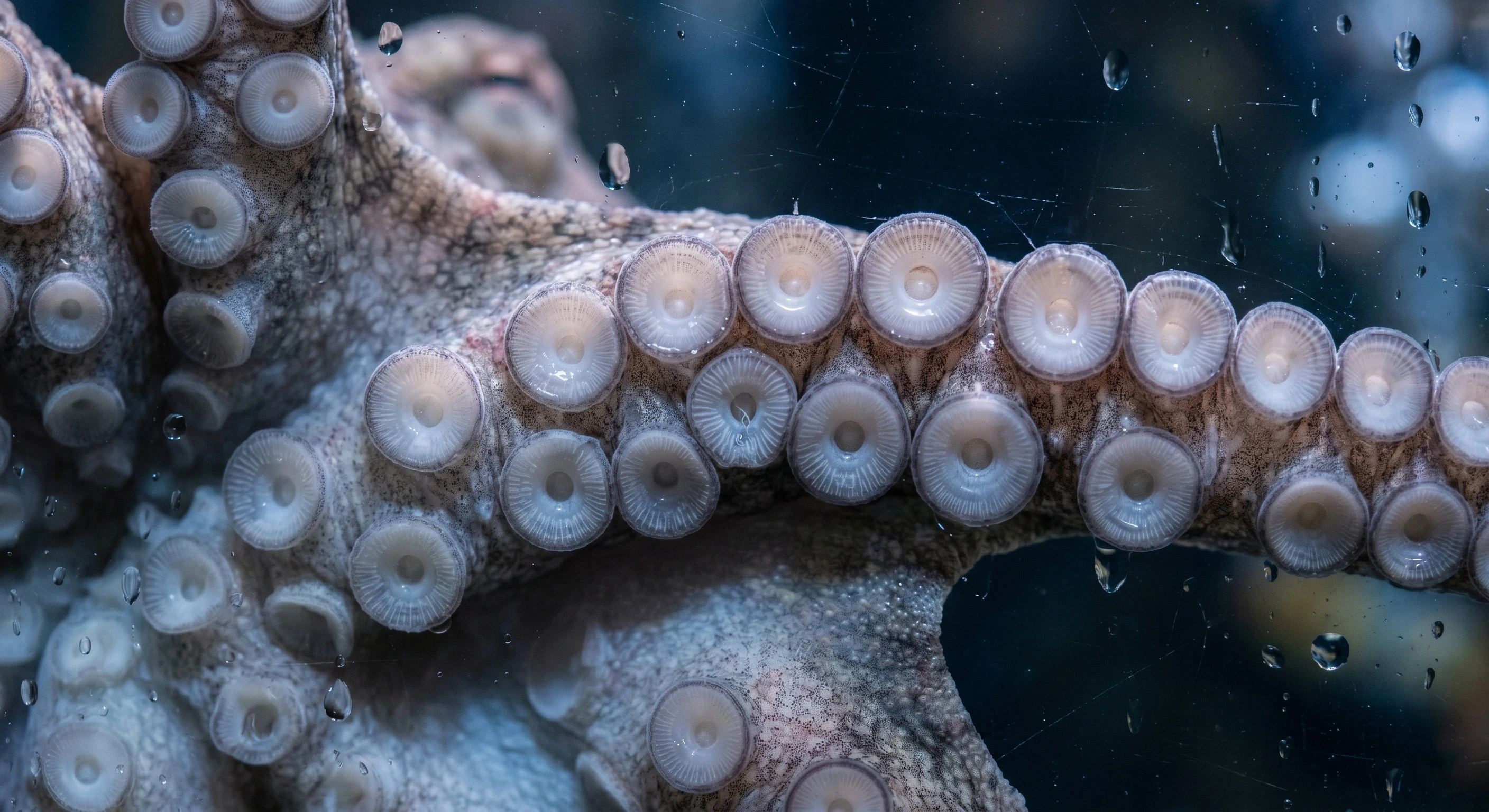
An octopus arm has no joints to count. Instead, the skin is covered in mechanoreceptors — pressure-sensitive cells that report contact, stretch, and resistance from thousands of points at once. The brain does not track position. It tracks effort and feedback. The arm navigates by feel, not geometry, which is why it can operate in total darkness just as well as in open water.
The elephant trunk is similar. The tip contains dense nerve endings — more per square centimetre than almost anywhere else on the animal's body. It reads texture, temperature, and vibration simultaneously. It does not calculate. It responds.
Forty thousand muscles and one decision
The trunk has roughly forty thousand individual muscle units. The octopus arm has its own dedicated nerve cluster — a mini-brain, in effect — that handles local movement without waiting for instruction from the head.
This is the part that stops you when you think about it long enough. These structures are not just flexible. They are computationally distributed. The load of figuring out how to move is spread across the entire appendage, not centralised in one place making ten thousand sequential decisions per second.
An octopus told to reach for food does not send a trajectory to its arm. It sends a goal. The arm works out the path on its own. Researchers have shown that even a severed octopus arm, kept alive in isolation, will continue to respond to touch stimuli and execute reaching motions. The intelligence is in the limb itself.
The elephant trunk operates differently — it is centrally controlled — but the sheer density of its muscle architecture means that each gross movement from the brain produces a cascade of micro-adjustments through the trunk automatically, without additional instruction. The control is top-down, but the execution is distributed by design.
Two answers to the same question
What these two animals share is not just anatomy. It is a philosophy of structure. Strength does not require rigidity. Precision does not require geometry. A body can be both powerful and soft, both responsive and controlled, if the architecture is right.
The elephant solved it with density, so many muscles, so many nerve endings, that brute force and fine touch live side by side in the same organ.
The octopus solved it with distribution, push decision-making into the limb itself, let local intelligence handle local problems, and free the brain for higher-order goals.
Both answers work. Both have been working for tens of millions of years.
In the next article, we will ask what happens when an engineer looks at both of these structures at the same time - and whether a robotic arm inspired by both might finally close the gap between the machine and the living thing.